California Certified Organic Farmers
For Neal Family Vineyards, organic is not a marketing angle,
At Neal Family Vineyards, organic is not a marketing angle. It is a commitment to our livelihood and that starts within the soils, and the only way you can have healthy soils is farming organically. It’s the food source for our vineyards, bringing our vineyards to be at the highest degree of resiliently.
The soils are unrestricted to continue to build and self-replenish healthy nutrient dense and biodiverse ecosystem. Soil organic matter improves the water holding capacity to allow dry farming or significantly less irrigation needs specially on low rainfall years. Soil drainage enhances which reduces soil erosion. Healthy vines can withstand extreme weather such as heat waves; this all can be done with healthy soils. The only way you can accomplish this is farming organic. With this our organic farming method doesn’t stop at the vineyard but throughout the whole property. Many consumers of Neal Family Vineyards claim that our wines do not give them headaches, rash or a hangover. Again, our farming method translates from the soil to the bottle, we are “The Farmer and Maker” of our Estate Vineyards.
Let’s look at what exactly being CCOF Certified Organic means.
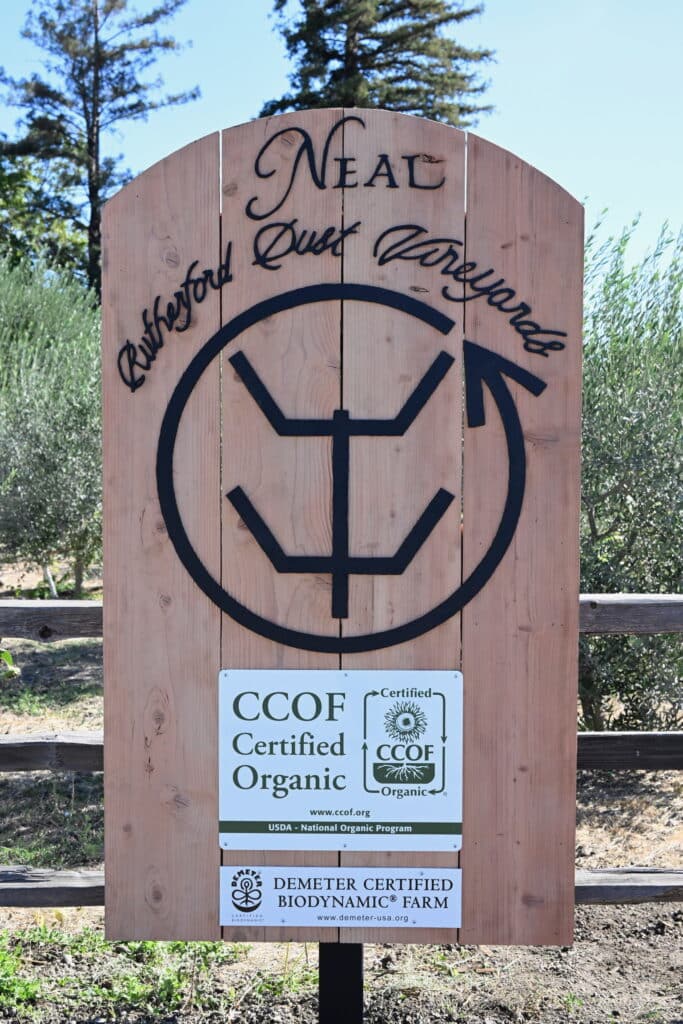
CCOF stands for California Certified Organic Farmers, a nonprofit organization that provides organic certification, education, advocacy, and promotion. When you see that a wine is CCOF Certified Organic, located on the back label, it means a complete circle from farming to producing/handling behind it have been verified with established organic standards by a USDA-accredited third-party certifier. The certification is not self-declared. The farm is inspected, products used such as composing, and insect control are regularly reviewed and documented. With this, farmers and producers of organic products can proudly display the certification on the label.
The CCOF seal signals something important: this is not vague language on a back label. It is a standard, backed by federal organic regulations and oversight through the USDA National Organic Program.
More Than a Claim
Organic has become one of the most used widely words in food and farming, but not every claim carries the same weight.
CCOF certification means a farm or operation must comply with the USDA organic regulations. There’s two CCOF certifications in the case for Neal Family Vineyards- one for growing/farming and one for production/handling and labeling. Both CCOF certificates are enforced through accredited certifiers, numerous of inspections, recordkeeping, and ongoing compliance. In other words, there is a system behind the seal.
That distinction matters more than ever. In a marketplace full of loose language, certification gives consumers a benchmark they can trust.
What It Takes to Become Certified
Becoming certified organic is not a quick switch.
Under USDA organic rules, land used for organic crops must go through a 3-year transition period without prohibited substances before the crop can be sold or labeled as organic. If for some reason during transition the farmer applies synthetic materials, GMO or non-ORMI approved materials the clock starts for another 3 years. During the 3-year transition, growers cannot use the USDA organic seal or represent the product as organic. The term organic is legally protected, and anything implying certifications is tightly regulated
Certification also requires an Organic System Plan, which documents how the farm meets the standards and how compliance is maintained over time. CCOF notes that this plan is central to the certification process, and regular inspections are part of that verification.
That is what people often miss. Organic certification is not simply about what you avoid. It is about how you farm, how you document it, and whether you can stand behind it year after year. CCOF also can provide grant money for transitioning to organic, and it’s one of the more structured programs available in California right now. Funding can be 10K per year for the 3-year during the transition period.
Why It Matters in Wine
In wine, the farming decisions made in the vineyard shape everything that follows.
Certified organic farming protects the integrity of the soil and allows the soil to continue to restore itself from depletion from the vineyard. The soil is accountable for the food source for the vineyard, cover crops and all flora around the vineyard and ultimately for how grapes are grown. For Neal Vineyards, it reflects there is a deeper respect for the vineyard itself when the whole property is organic. Healthy soils, thoughtful stewardship, and transparency are not trends for the Neal Family and Neal Vineyards. They are foundational.
At Neal Family Vineyards, our way of farming aligns with how we have always viewed the responsibility of growing and producing wine in Napa Valley. The goal is not to chase labels for appearance. The goal is to farm with intention and to bottle wines that honestly reflect where they come from.

Why Certification Still Matters
Consumers are asked to navigate more and more language on labels today — natural, clean, regenerative, green, responsibly farmed. Much of this language is loosely defined, inconsistently used and downright deceiving marketing tactics.
Organic certification is different because it is tied to a formal standard. CCOF explains that the USDA and CCOF seals indicate food has been grown and produced according to federal standards, and its consumer education materials also distinguish regulated organic claims from unregulated marketing language.
That kind of clarity matters.
Because when a bottle says organic, consumers should not have to guess what that means.
A Standard Worth Standing Behind
CCOF Certified Organic means more than checking a box. This Organic Certification represents accountability, verification, and a long-term commitment to farming and producing wine with integrity.
For Neal Family Vineyards, that matters because the best wines begin long before harvest and before the cellar. They begin with the soil, the care given to it, and the standards one is willing to uphold even when no one is watching.
That is what certification means to us at Neal Vineyards.
And that is why it matters.
Source links
• CCOF — California Certified Organic Farmers: https://www.ccof.org/
• CCOF: Why Organic?: https://www.ccof.org/why-organic/
• USDA National Organic Program: https://www.ams.usda.gov/about-ams/programs-offices/national-organic-program
• USDA Organic Regulations: https://www.ams.usda.gov/rules-regulations/organic
• USDA: Becoming a Certified Operation: https://www.ams.usda.gov/services/organic-certification/becoming-certified
• CCOF: How to Read Organic Labels: https://www.ccof.org/why-organic/how-to-read-organic-labels/