
How a question in a Rutherford vineyard became a soil-first innovation for varietal diversity, cooler microclimate, natural shade, and more thoughtful use of every acre, with less inputs.
For Mark Neal, one of those questions came into focus as the foundation and caves for the Estate Winery were being built. Neal Family Vineyards had Cabernet Sauvignon rooted in Rutherford and Howell Mountain, but Mark saw something missing from the estate story: the needs of a white wine grown from his own land.
At Neal Family Vineyards, innovation has never started to be a trend however earn to be one. In the case of the Dual Varietal Trellis System. It starts in the vineyard to grow a white variety without shade cloth. By watching the sun move across a block in the spring and summer of ’96, reading the soil, and asking what will the white variety need in order to grow better fruit by first not using shade cloth, limit to or not having direct sun on the skins of the white variety and this would also slow down leaching out the fruit acid.
The challenge was Rutherford itself. White grapes grown in direct Napa Valley sunlight can add to much amber and sunspots on the grape skins, the results would be a dark yellow in the glass and lose natural fruit acid before the flavors are where they need to be. Mark wanted a different answer. He wanted to grow white grapes in Rutherford without synthetic shade cloth, without buying more land, and without clearing more wild space.
His answer became the Dual Varietal Trellis System, an innovation Mark first developed in 1997 at the Neal family’s Rutherford Dust Vineyard. What began as a way to grow an estate white wine became a vineyard system that supports small-estate diversification, covers the soil from direct sunlight, reduces evaporation from the vineyard floor and the leaves of the vines, (unitizing less water and reducing vigor) increases canopy biomass, and makes more complete use of each acre already under care.
“What I wanted to do was grow white grapes in Rutherford without shade cloth. What I found was a whole new way to farm the same acre that benefits both the wines, the land and environment.”
– Mark Neal
An Idea Rooted in Rutherford
Mark has been farming in Napa Valley since childhood. His parents purchased their Rutherford property in 1966, and Mark began working alongside his father through Jack Neal & Son Vineyard Management in 1968. Over the decades, he watched Napa Valley evolve from a region of mixed agriculture and diverse grape varieties into one increasingly centered on Cabernet Sauvignon.
Cabernet Sauvignon has earned its place in Napa, especially in Rutherford, Howell Mountain, and Oakville. But Mark also remembers another Napa Valley: one shaped by generational farmers, immigrant families, Mediterranean influence, and a wider range of grapes planted across a single property. Older farmers understood the risk of putting everything into one basket. Agricultural diversity created resilience, and vineyard diversity helped protect a property from the pressure of one variety, one market, or one weather pattern.
That diversity began to narrow as land values rose, farming costs increased, and consumer demand made Cabernet Sauvignon the economic anchor of many Napa Valley vineyards. After replanting most of Napa Valley due to phylloxera in the late 1980s and early 1990s, many blocks moved toward more uniform vineyard designs. White varieties in warmer valley-floor sites became harder to justify. In hot years, exposed white fruit created amber and dark spots on the skins and the lost of acidity with trellis systems. Older head-pruned vines often offered more natural shade but lower production.
The Dual Varietal Trellis System was Mark’s way of challenging that assumption without walking away from Rutherford. He wanted to stay within the existing vineyard footprint and plant an area not used and utilize the soil without asking more land to be planted. In Rutherford doubling up the vines per acre decreased a vigorous site.
Our Rutherford Dust Vineyard has been in the higher end soil of soil organic matter (SOM) with levels exceeding 8-9% which are achieved through regenerative organic farming for more than 50 years. This elevated range delivers critical benefits for water retention, vine resilience, and nutrient cycling due to the SOM being in the 8-9% verse the average of 2%.
“If my dad had been alive in 1997, I am not sure if he would have accepted this innovation on his property”
– Mark Neal
That is part of the Neal story, too. Innovation is not always obvious at first. Sometimes it looks unconventional before it proves itself in the field and in wine.
The First Trial
In 1997, Mark planted the first prototype in the middle of Rutherford Dust Vineyard. He chose a small two-acre trial so he could study it, modify it, and, if it did not work, remove it without disrupting the larger vineyard.
The first combination was Zinfandel above Sauvignon Blanc below. Mark built the system on a modified California Sprawl structure, using what he describes as an elkhorn-style trellis. Rather than forcing the vines into a tight vertical wall, the design allows each canopy to move outward and down in a way that works with the vine’s natural growth and sprawl.
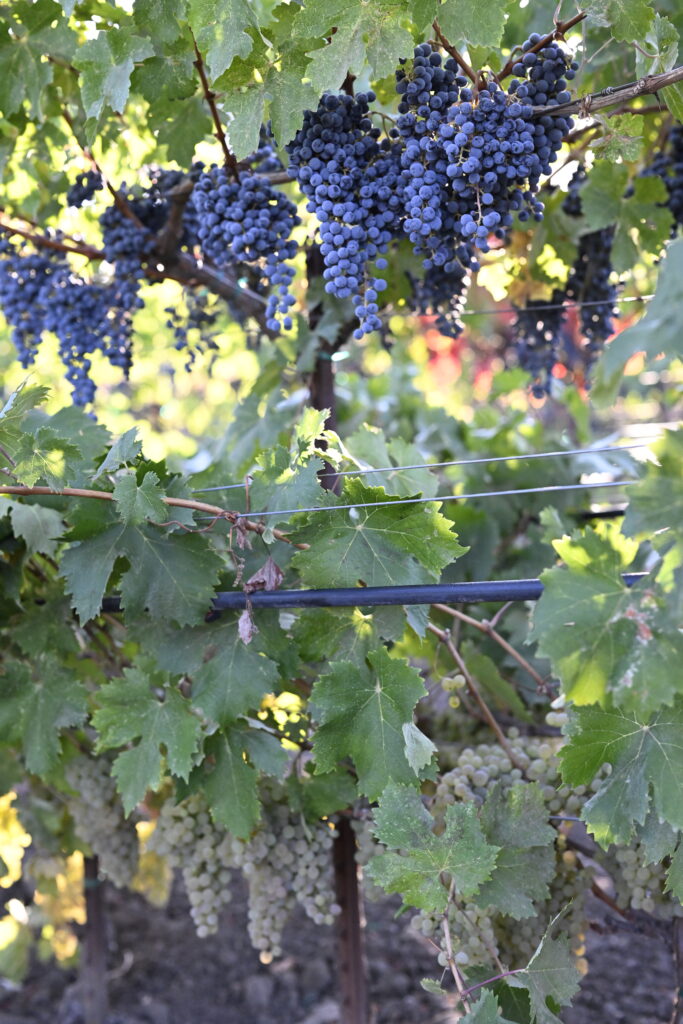
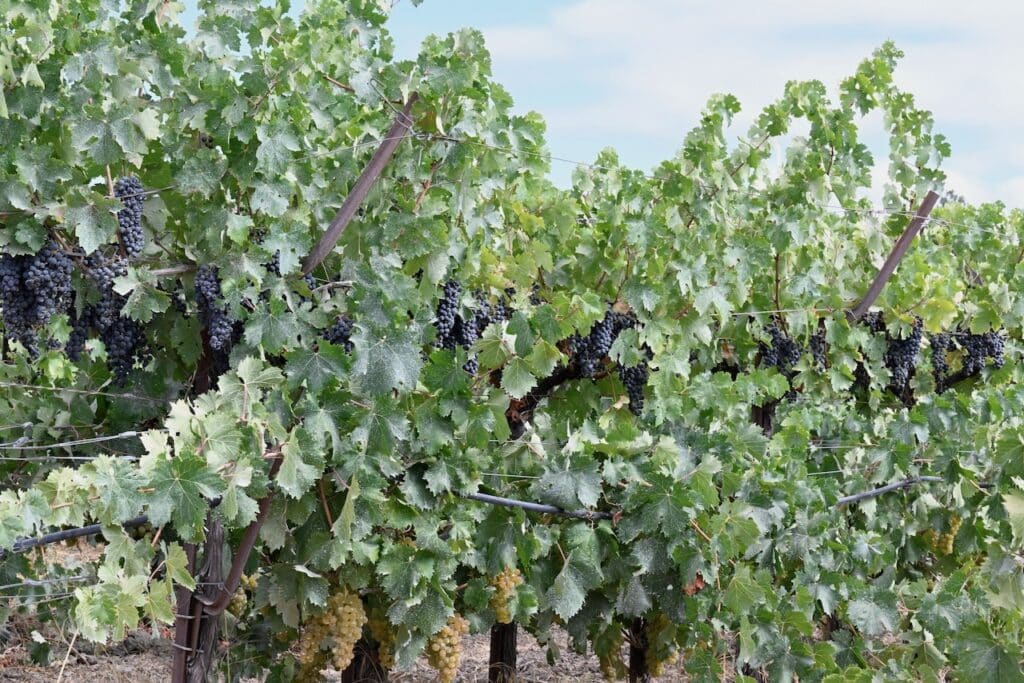
The red variety is trained above, where it receives the sun it needs for canopy sprawling, color and ripening. The white variety is trained below, where it grows under the natural sunshade of the upper canopy. Each vine has its own rootstock, its own fruiting wires, and its own canopy space. The two canopies are separated so they do not compete directly or crowd each other in the fruit zone. However, the roots are mingling below working with a higher water holding soil organic matter, higher carbon and higher carbohydrate return.
In the simplest terms, every other vine is a single red variety and below is a single white variety. The result is a living, layered vineyard row: red grapes above, white grapes below, and both varieties sharing the same acre without sharing the same fruit or canopy zones.
How the System Works
The upper canopy acts as a natural sunshade. It shields the lower white fruit from direct sunlight while still allowing dappled light and airflow to move through the row. That dappled light is important. The goal is not darkness. The goal is a cooler, more protected microclimate where white grapes can ripen with freshness, golden straw color, and acidity intact.
For white varieties, that cooler zone matters. Too much sun exposure can cause skins to amber and acid to fall before flavor is fully developed. By using the red canopy above as a living umbrella, Mark can extend the growing window and protect the clean, bright character he wants in the glass.
“The top canopy becomes a natural umbrella for the white fruit. It gives us dappled light, a cooler zone, and the natural fruit acid we want in the glass.”
– Mark Neal
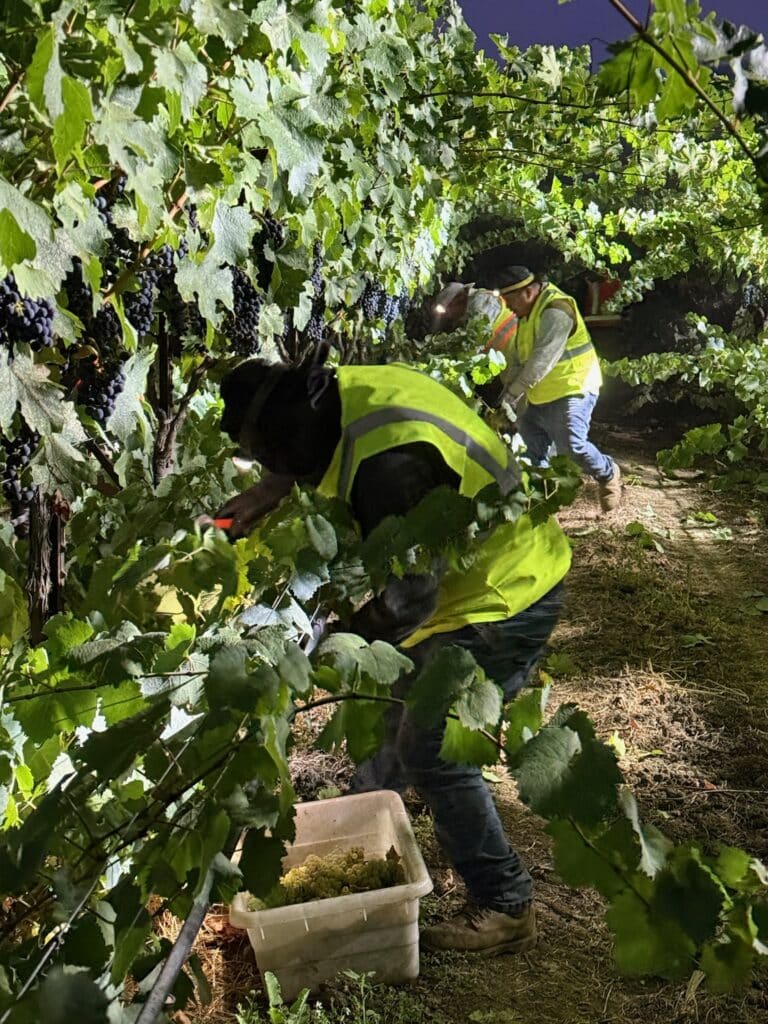
The system also requires experience. Variety selection matters. The vigor of the red and white vines needs to be balanced so one does not overwhelm the other. Pruning, shoot positioning, fruit exposure, and canopy timing all have to be managed with precision. The idea may be easy to describe, but the execution depends on decades of vineyard observation.
In Mark’s Rutherford Dust Vineyard, the upper canopy has included varieties such as Cabernet Sauvignon and Zinfandel. Below, Mark has grown or trialed white and Mediterranean varieties including Sauvignon Blanc, Sauvignon Vert, Semillon, Vermentino, Albariño, Fiano, Chenin Blanc, Melon, Assyrtiko, Malagousia, and Moschofilero. These are not varieties most people expect to find rooted in Rutherford, which is exactly why the system matters.
The Vineyard Floor Matters
The most visible part of the Dual Varietal Trellis System is the canopy, but one of its most important effects happens at the vineyard floor.
Once fully developed, the two canopies shade the ground from row to row and vine to vine. That shaded floor reduces radiant heat, slows surface evaporation, and helps the vineyard hold moisture for longer. Mark has observed that fully exposed vineyard ground can become dramatically hotter than shaded ground during the middle of summer, with shaded soils often staying significantly cooler depending on conditions.
That temperature difference changes the life of the soil. When the vineyard floor is exposed to direct sun, soil moisture near the surface can evaporate quickly, organic matter can oxidize more rapidly, microbial activity near the surface can decline, and feeder roots can be stressed. Under a shaded canopy, moisture remains available longer, cover crops can continue growing deeper into the season, and biological activity has a better chance to continue cycling nutrients through the system.
The dual canopy also slows wind movement through the row, further helping reduce moisture loss. For Mark, these are not side benefits. They are central to why the system works.
The Soil Makes It Possible
The trellis may be the visible innovation, but for Mark, the foundation has always been the soil.
Neal Family Vineyards has long been rooted in certified organic farming, Biodynamic® farming, and Regenerative Organic Certified® agriculture. These are not labels added after the fact. They are the framework that allows the vineyard to be more resilient, more biologically active, and more capable of carrying a denser planting system with fewer outside inputs. He doesn’t believe that an noncertified organic vineyard could thrive after all the soil is sustaining a lower quality of living with synthetic materials.
Mark is clear that the Dual Varietal Trellis System is not simply about putting more vines into the ground. It only works when the soil can support the increased demand. At Rutherford Dust Vineyard, decades of organic, Biodynamic® and Regenerative Organic farming methods have helped build soil organic matter (SOM), water-holding capacity, microbial life, carbon return all to aid root strength. That living foundation allows the vineyard to carry two varieties in one row without sacrificing quality.
“This trellis only works if the soil is alive enough to carry it. The structure is above ground, but the strength is below our feet.”
– Mark Neal
More canopy also means more photosynthesis, more biomass, more root activity, and more carbon cycling back into the soil. It’s been estimated that the Dual Varietal Trellis System can create two to four times the total canopy biomass per acre compared with a conventional single-variety block, depending on the site and variety combination. More leaf area, more permanent wood, and more active roots can mean more carbohydrates moving through the plant and more root exudates feeding soil biology.
For Mark, soil organic matter is the long-term reservoir. As it builds, the soil becomes more structured, more alive, and better able to hold water. Multi-species cover crops, compost, animals, and the absence of synthetic chemical inputs all support that cycle. The Dual Varietal Trellis System adds another layer by increasing the vineyard’s living canopy and shading the soil that supports it.
That is why Mark would not advise this system for a high-input vineyard where the soil has not been built to carry it. The trellis is the tool. The soil is the reason the tool can work.
More Fruit, Less Expansion
One of the clearest advantages of the Dual Varietal Trellis System is its ability to increase production from the same vineyard footprint. At Rutherford Dust Vineyard, Mark is effectively farming 18 acres in a way that can produce like 36 acres, depending on block, variety, and vintage.
But Mark does not see the system as simply a way to grow more fruit. He sees it as a way to diversify production, make better use of an existing estate, and reduce the pressure to expand outward. The system allows a small property to grow red and white varieties from the same acre without purchasing additional land or removing surrounding habitat.
The economics also matter. Doubling the vines does not double the major costs of farming. Equipment passes are based on the existing acreage, not the equivalent production acreage. Organic materials are applied to the land footprint that exists. In Mark’s experience, hand labor increases, but not at a full two-times rate. The result is a system that can increase output and diversity while keeping many vineyard operations tied to the original acreage.
That matters in Napa Valley, where land is limited, farming costs are high, and every acre needs to justify its place. For Mark, the point is not to ask the land for more than it can give. The point is to understand what the land can do when the soil is healthy, the canopy is intentional, and the farmer is willing to rethink the row.
A Future for Varietal Diversity in Napa Valley
The Dual Varietal Trellis System also opens a larger conversation about varietal diversity in Napa Valley.
In many parts of the Valley, the economics of farming have favored Cabernet Sauvignon for decades. That focus is understandable, but it also narrows what is planted, what is made, and what future generations may come to know as Napa wine. Recent market pressure has also reminded growers that a one-variety economy carries risk.
Mark’s system offers another path. By using the upper canopy for red varieties and the lower canopy for white varieties, a vineyard can continue producing high-quality red fruit while also creating space for white grapes that might otherwise be difficult to grow in warmer sites. For small estates and wineries, that can mean more diversity without needing more acreage.
This is how varieties like Vermentino, Albariño, Fiano, and Assyrtiko have found a place at Neal Family Vineyards. It is also why Mark continues to experiment with Mediterranean and Greek varieties as part of a broader look at how Napa Valley can adapt without losing its farming identity.
“Napa does not have to lose its varietal diversity. This system gives small estates a way to diversify, protect the land they already have, and create a more powerful environmental return from the same acre.”
– Mark Neal
The future of farming will require more than one answer. It will require growers to view their land carefully and maybe differently. Great viticulturist must respond to heat and water pressure honestly and make decisions that protect both wine quality and the long-term soil health and the vineyard. For Mark, certified organic farming remains the starting point, because it is the clearest way to protect the soil, the vines, the people farming the land, and the consumers who drink the wine.
Innovation, the Neal Way
The Dual Varietal Trellis System is visually striking in person, especially from summer through harvest. Photos rarely capture the full effect. Visitors see red clusters overhead, white clusters below, and two separate canopies sharing one row.
But like many of Mark’s innovations, it was not designed to be noticed. It was designed to solve a problem. The same was true of night harvesting. In the late 1970s, Mark began harvesting in cooler weather for the benefit of the vineyard crew. Years later, the wine quality benefits became clear as fruit arrived at the winery cooler, fresher, and in better condition.
The Dual Varietal Trellis System followed a similar path.
It began with a practical question: how can we grow an estate white wine in Rutherford without direct sun damage and without shade cloth? Over time, it became a system that protects acidity, shades the soil, supports varietal diversity, increases biomass, and makes more thoughtful use of the vineyard acre.
It continues to evolve, shaped by each vintage and by Mark’s lifelong belief that good farming starts with observation. For Neal Family Vineyards, the Dual Varietal Trellis System is more than a vineyard design. It is a reflection of the family’s history on this land: practical, inventive, soil-first, and always rooted in the belief that wine begins long before it reaches the cellar.
Award-winning wines from our Rutherford Dust Vineyards
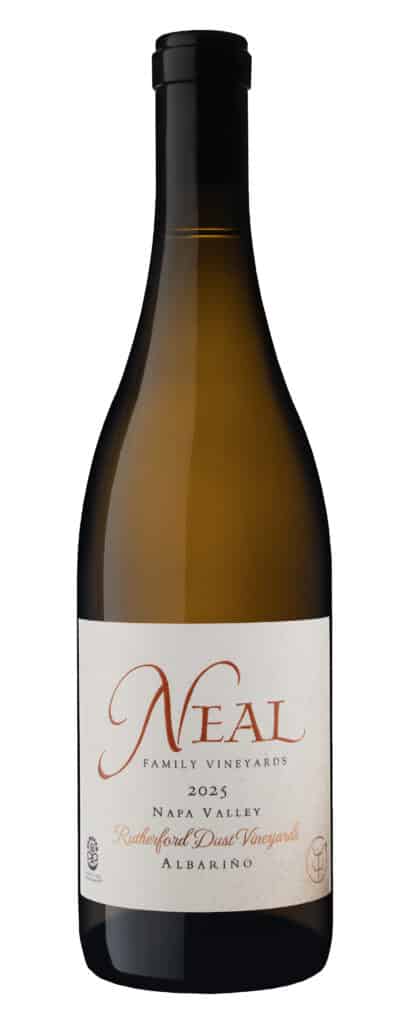
2025 Rutherford Dust Biodynamic® Albariño
Inviting aromatics spill effortlessly from the glass, bursting with ripe pear, mandarin, citrus peel, jasmine, honeysuckle, and a touch of fresh ginger. In the glass, the wine shines a pale yellow with vibrant lime hues. The palate is medium-bodied, crisp, and lively, offering a smooth yet energetic texture. Flavors of quince and pear lead, supported by bright pomelo, citrus peel, and a subtle spice that adds depth and intrigue. This Biodynamic® Albariño finishes clean, fresh, and pure, with a long, refreshing lift that invites the next sip.
Wild yeast fermentation—drawn from the rich biodiversity of our Rutherford vineyards—combined with minimal intervention allows this Estate Biodynamic® Albariño to express an authentic and unmistakable sense of place.
A natural choice for spring and summer, this wine is equally at home enjoyed with a book by the fire, on a covered porch, or alongside a sunset at the beach. Pair with fruit-forward salads, light fish dishes, or simply good company.
92 pts- James Suckling